Most Healthcare AI Isn’t Blocked by Regulation. It’s Blocked by Internal Friction.
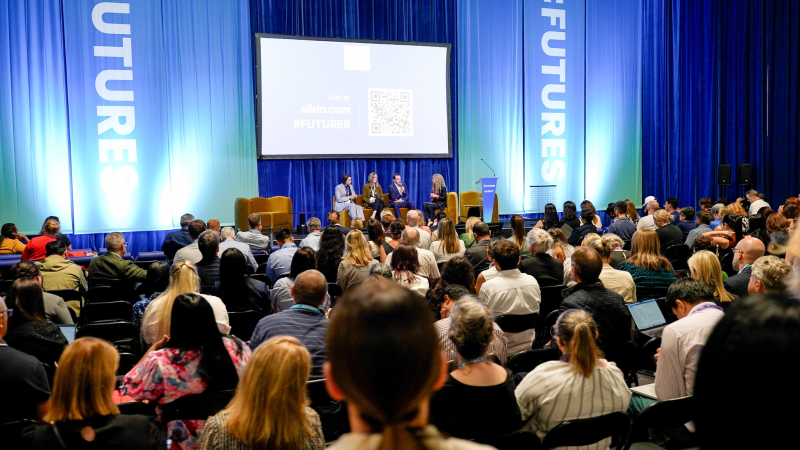
Walk the floor at Australian Healthcare Week and it's easy to get swept up in the vision of a frictionless, AI-driven future for healthcare. But according to Ken Gallacher, reflecting on the event alongside the Equal Experts team, the conversation among the digital leaders actually tasked with delivering that future has already moved past the hype and the pilots. The challenge now is building the foundations of an AI-ready organisation — integrated data, embedded governance, clinical support, public trust and operating models that can flex as AI scales.
Nearly every healthcare organisation now treats AI as a strategic priority. What varies enormously is speed: some are running clinical pilots and standing up governance frameworks, while others are still working on data readiness and infrastructure modernisation.
From AI Hype to Operational Reality
Speaking on a panel titled "Creating a 15-year AI Roadmap," Equal Experts APAC CTO Andy Canning argued that the defining challenge for 2026 is shifting from AI hype to operational reality. Getting real-world value beyond the pilot phase, he said, requires a strategy built on strong foundations across data, infrastructure, governance and culture — the unglamorous groundwork that determines whether innovation translates into sustainable clinical outcomes.
Scoring Your Own AI Readiness
To make that abstract idea concrete, Equal Experts ran a live AI Governance Maturity Assessment on-site: a five-minute, 20-factor evaluation giving leaders an instant readiness score and recommendations across five pillars — Alignment & Strategy, Data & Technology, Operations & Monitoring, People & Culture, and Trust & Governance. The exercise made a point that echoed across the event: an organisation can be confident in its overall AI strategy while still carrying real gaps in process or internal culture.
Internal Friction Slows AI More Than Regulation
Perhaps the sharpest insight came out of an Equal Experts roundtable with 16 digital leaders. The consensus: board approvals, too many committees, funding cycles, fragmented systems and poor APIs are bigger barriers to AI adoption than regulation itself. Leaders who focused on fewer, more scalable initiatives — rather than a scattershot of pilots — and who embedded governance into existing practices rather than bolting it on, moved noticeably faster.

Equal Experts Roundtable at Australian Healthcare Week 2026
The roundtable also underlined a simple but often-ignored rule: human-in-the-loop only works if it's meaningful. AI should support clinical judgement through workflows that are intuitive and save real time. If the interaction isn't natural or genuinely useful, clinicians will simply route around it.
Early findings from Equal Experts' ongoing AI by Design in Healthcare research reinforce the same picture: AI has become a leadership-level priority stretching well beyond IT, data foundations remain the make-or-break factor for scaling safely, and AI is forcing an end to the piecemeal, department-by-department rollouts that defined previous waves of health tech.
Read Ken Gallacher's full reflections via Equal Experts: Building AI-ready health systems: Reflections from Australian Healthcare Week 2026
Conversations like these are exactly what Healthcare 2040 Expo (co-located with Australian Healthcare Week) was built for — bringing together the leaders shaping AI, digital health and the future of care across Australia. Join us 17–18 March 2027 at ICC Sydney.